
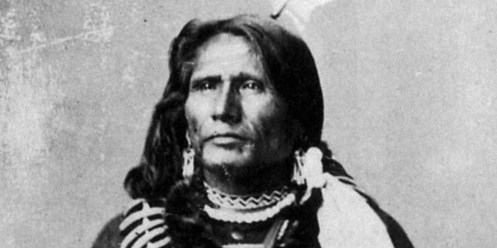
From Higher Perspective, January 11, 2016
Chief Standing Bear was a chief of the Oglala Lakota Sioux. He was raised with the traditions of his people until he was 11, when he was taken to the Carlisle Indian Industrial Boarding School in Pennsylvania. There, he would learn English and the American way of life.
Still, he was rooted deeply in his home two thousand miles to the east. This is what he had to say about modern society.
1. Everything was possessed of personality, only differing from us in form. Knowledge was inherent in all things. The world was a library and its books were the stones, leaves, grass, brooks, and the birds and animals that shared, alike with us, the storms and blessings of earth. We learned to do what only the student of nature learns, and that was to feel beauty. We never railed at the storms, the furious winds, and the biting frosts and snows. To do so intensified human futility, so whatever came we adjusted ourselves, by more effort and energy if necessary, but without complaint.
2. …the old Lakota was wise. He knew that a man’s heart, away from nature, becomes hard; he knew that lack of respect for growing, living things soon led to lack of respect for humans, too. So he kept his children close to nature’s softening influence.
3. It was good for the skin to touch the earth, and the old people liked to remove their moccasins and walk with bare feet on the sacred earth… the old Indian still sits upon the earth instead of propping himself up and away from its life giving forces. For him, to sit or lie upon the ground is to be able to think more deeply and to feel more keenly. He can see more clearly into the mysteries of life and come closer in kinship to other lives about him.
4. With all creatures of the earth, sky and water was a real and active principle. In the animal and bird world there existed a brotherly feeling that kept the Lakota safe among them. And so close did some of the Lakotas come to their feathered and furred friends that in true brotherhood they spoke a common tongue.
5. This concept of life and its relations was humanizing and gave to the Lakota an abiding love. It filled his being with the joy and mystery of living; it gave him reverence for all life; it made a place for all things in the scheme of existence with equal importance to all.
6. Silence was meaningful with the Lakota, and his granting a space of silence before talking was done in the practice of true politeness and regardful of the rule that ‘thought comes before speech.’…and in the midst of sorrow, sickness, death or misfortune of any kind, and in the presence of the notable and great, silence was the mark of respect… strict observance of this tenet of good behavior was the reason, no doubt, for his being given the false characterization by the white man of being a stoic. He has been judged to be dumb, stupid, indifferent, and unfeeling.
7. Praise, flattery, exaggerated manners and fine, high-sounding words were no part of Lakota politeness. Excessive manners were put down as insincere, and the constant talker was considered rude and thoughtless. Conversation was never begun at once, or in a hurried manner.
8. Children were taught that true politeness was to be defined in actions rather than in words. They were never allowed to pass between the fire and the older person or a visitor, to speak while others were speaking, or to make fun of a crippled or disfigured person. If a child thoughtlessly tried to do so, a parent, in a quiet voice, immediately set him right.
 Openhearted Rebellion